guideXOS Navigator Browser
Purpose: describe what the current browser stack can do today, and where it is still intentionally limited.
Navigator is real, not just a placeholder
The repo contains a substantial navigator.cpp implementation plus HTTP and HTML parsing helpers. Built-in app metadata marks
guideXOS Navigator as available in both hosted and bare-metal paths, and hosted smoke diagnostics in server.cpp
exercise Navigator behavior in detail.
Current status: functional browser work with clear hosted validation. Known gaps: HTTPS remains environment/policy gated; JavaScript and full parity across environments remain outside the current milestone. Back to /Wiki/Server
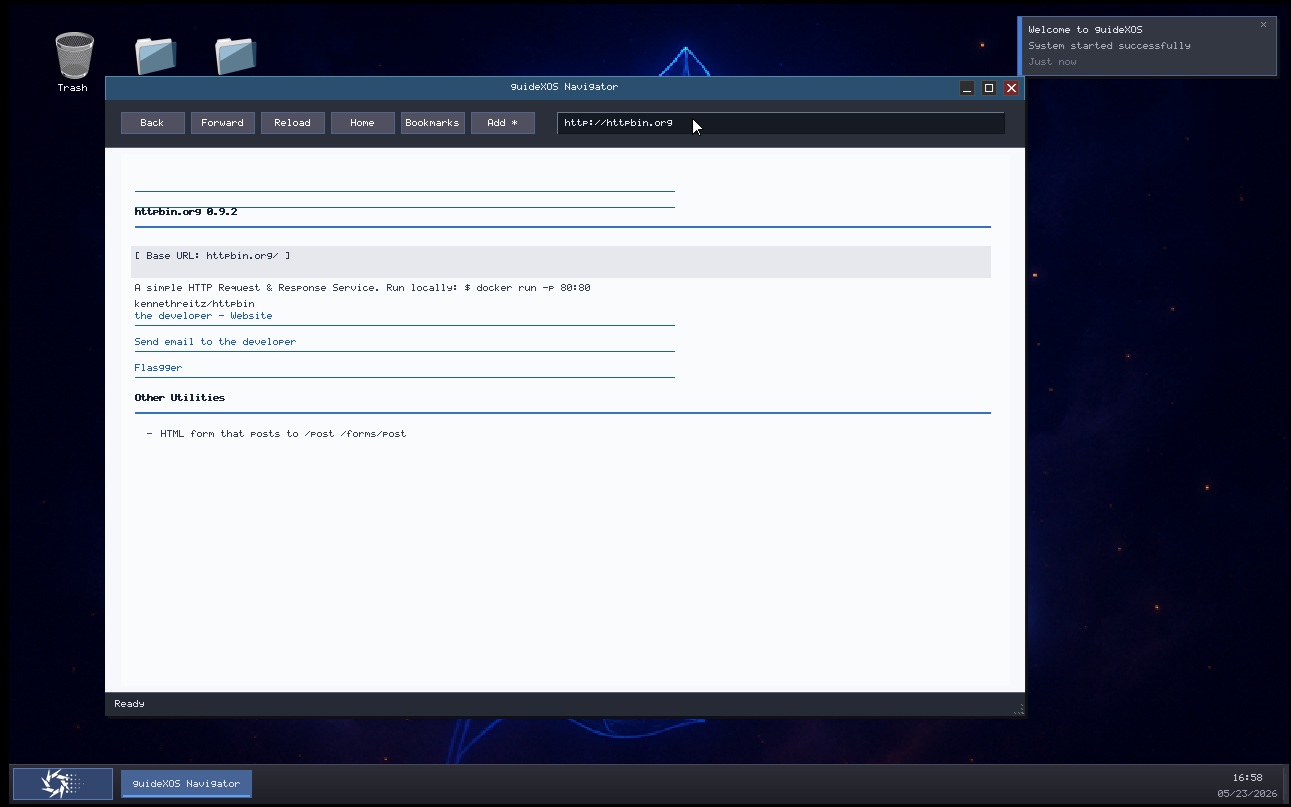
guideXOS Navigator in the current hosted desktop environment.
Capabilities visible in current source
| Capability | Status | Notes |
|---|---|---|
| HTTP text document fetching | Implemented | guide_web_http.h exposes plain http:// GET/POST support for text documents. |
| URL parsing and relative link resolution | Implemented | HTTP URL parsing and forgiving relative-link resolution are explicit in the code. |
| HTML subset parsing | Implemented | Parser supports headings, paragraphs, links, lists, pre/code, forms-lite controls, images, and embedded style blocks. |
| Forms-lite | Partial | Hosted smoke diagnostics explicitly mention GET forms and hosted POST behavior, while also documenting bare-metal POST as unsupported. |
| Bookmarks and find-in-page | Implemented | Hosted smoke diagnostics call both out as active capabilities. |
| Remote images and local PNG support | Partial | Navigator source and hosted smoke diagnostics show image handling work, but with explicit limits and safety caps. |
| TLS / HTTPS | Policy / environment gated | Hosted Navigator uses Schannel; the bare-metal path requires secure entropy and other validated TLS prerequisites. |
| JavaScript, cookies, compression, caching | Planned / Out of scope | These are explicitly outside the current milestone in the HTTP layer comments. |
Hosted path
Best-evidenced mode today. Hosted diagnostics in server.cpp explicitly test Navigator window creation, toolbar widgets, HTTP, file pages, CSS-lite, forms-lite, and link behavior.
Bare-metal path
Navigator is registered as available in bare-metal metadata and kernel app registration, but detailed parity with hosted behavior should still be treated carefully.
PartialHTTPS/TLS and secure entropy
Navigator's HTTPS/TLS path is different from plain HTTP. Mbed TLS / PSA crypto must receive cryptographically secure random data before TLS operations can safely proceed. The supported bare-metal OS random path currently consumes QEMU's transitional PCI virtio-rng device when the launcher exposes it. Without secure entropy, crypto initialization and TLS fail closed rather than falling back to timer values or deterministic pseudo-random data.
QEMU may therefore establish the entropy prerequisite for HTTPS in a way that a physical machine currently cannot. This is a hardware-like virtual RNG source, not TLS emulation or a bypass. See Build and Testing for the exact QEMU arguments and troubleshooting markers.
HTTP does not require the RNG. HTTPS also depends on the current trust-store, wall-clock, hostname-validation, and policy checks, so a working HTTP connection does not prove that TLS is ready. Broader bare-metal HTTPS remains fail-closed until the complete validated policy is active.
See also
- Server Build and Testing — QEMU launch, secure entropy, and HTTPS troubleshooting.
- Developing Apps with Developer Studio — the practical Native GUI Application workflow.